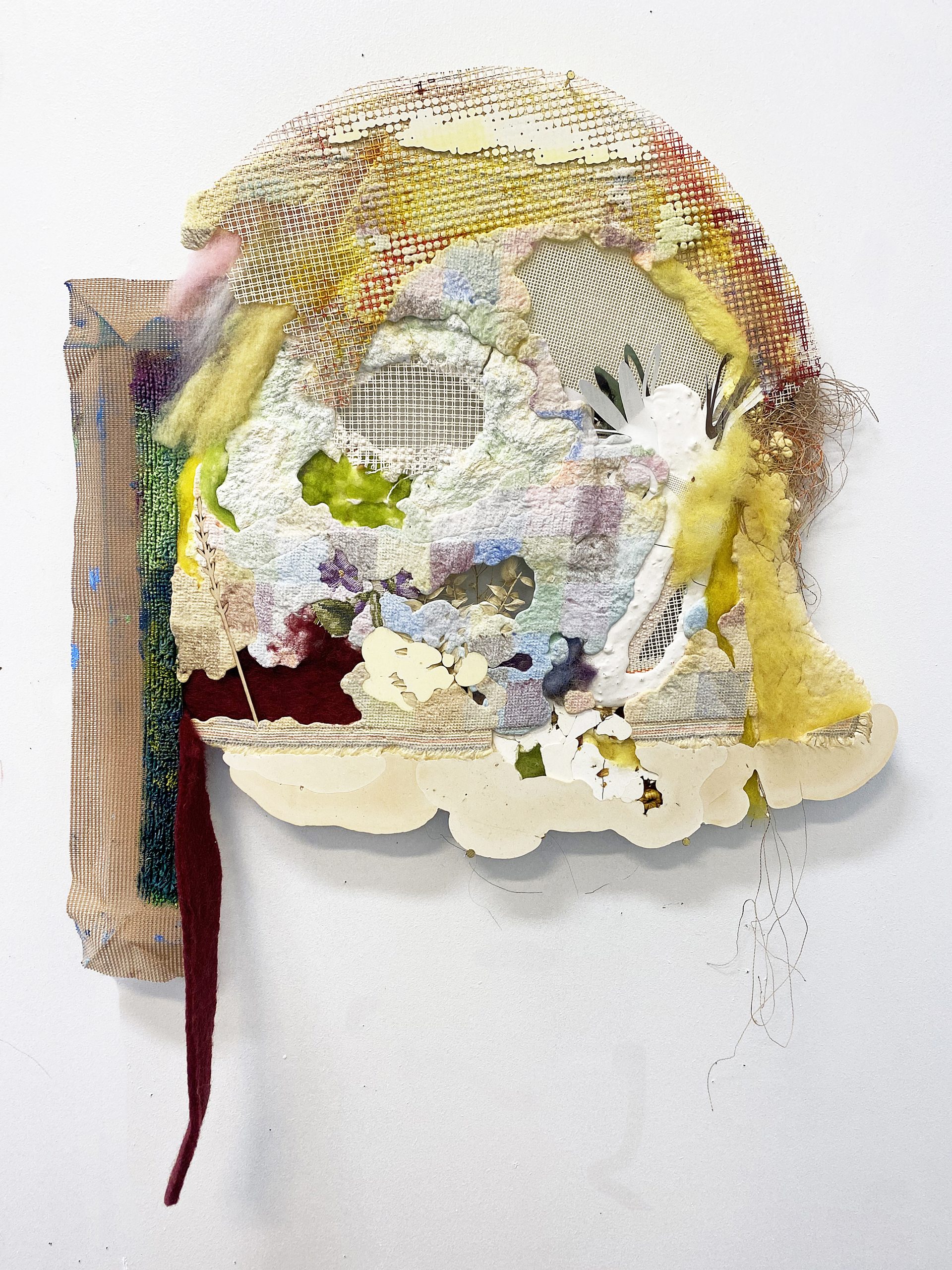
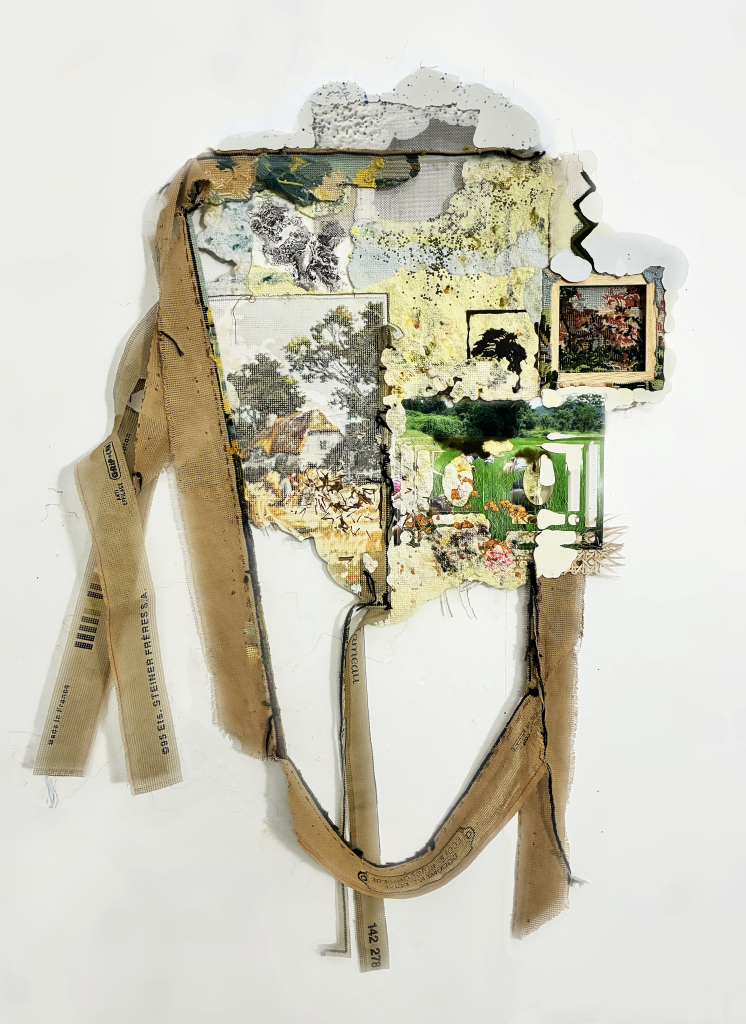
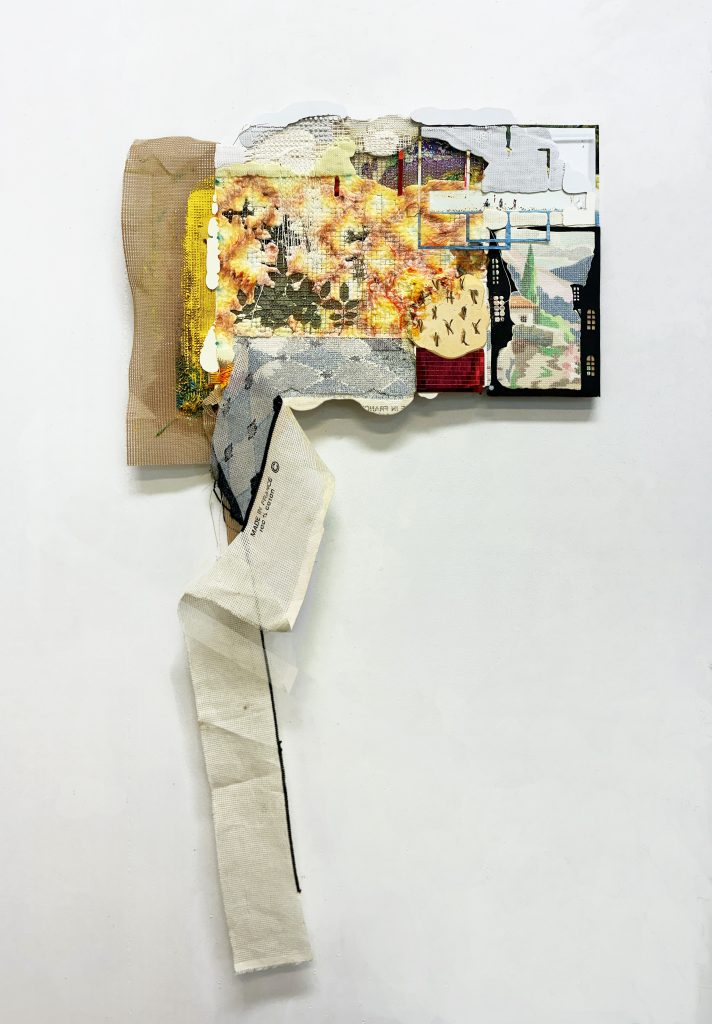
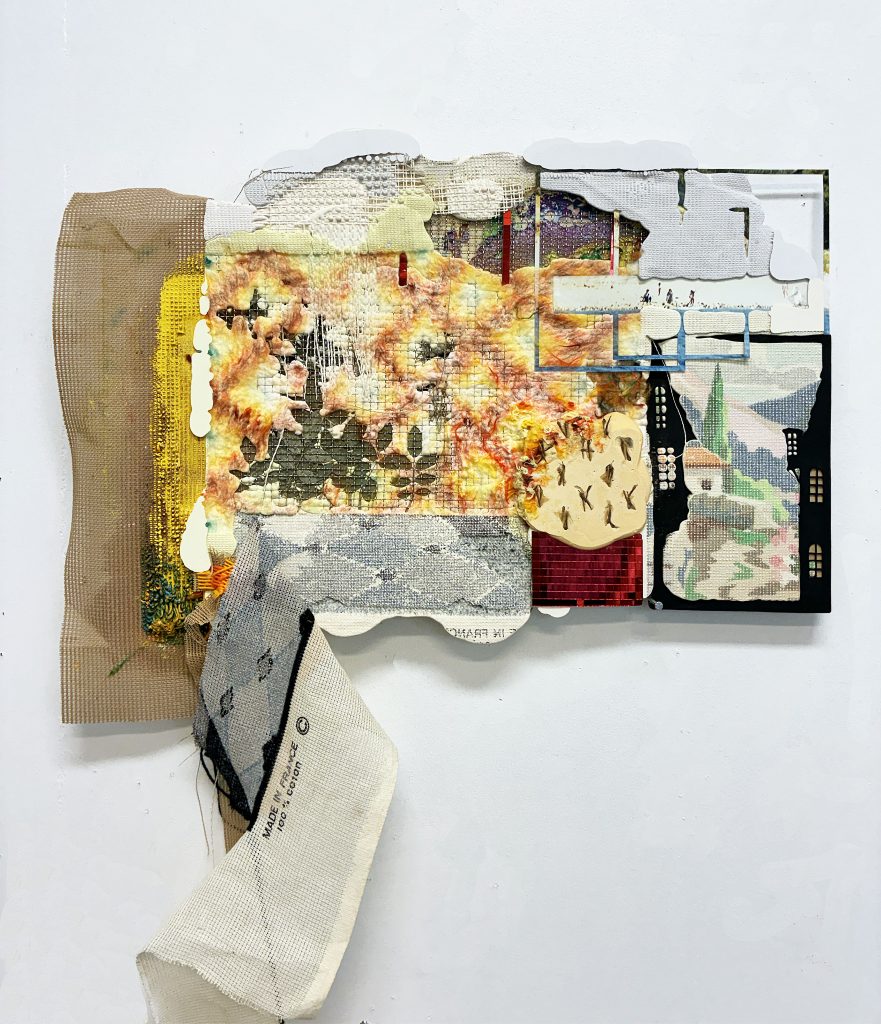
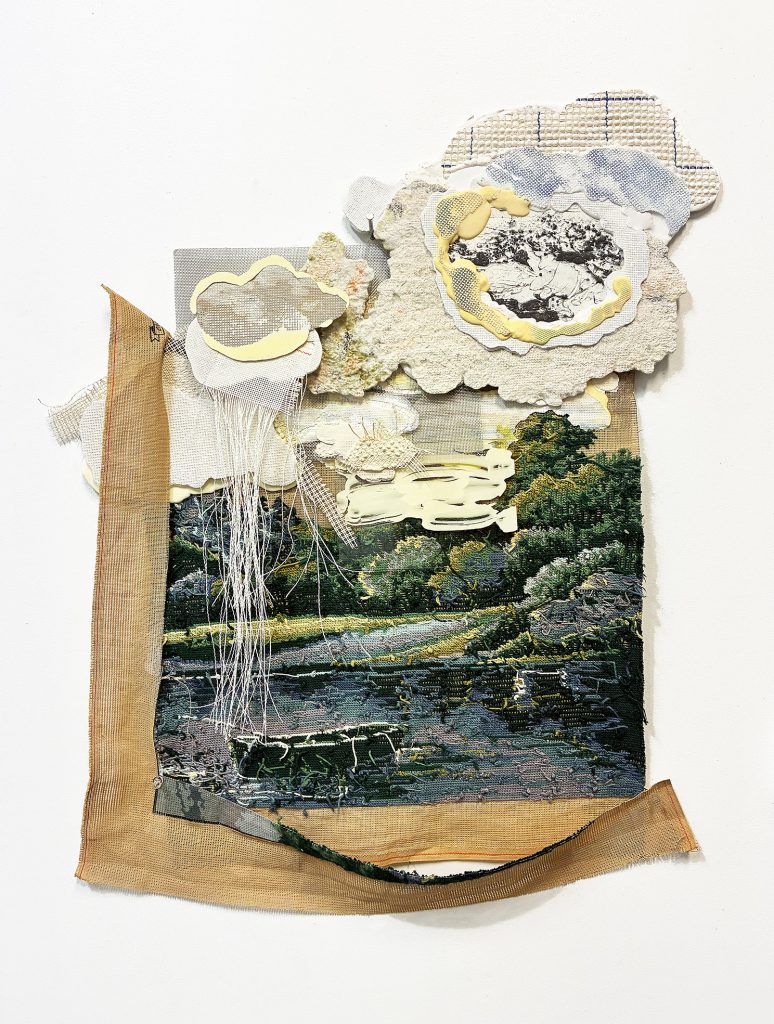
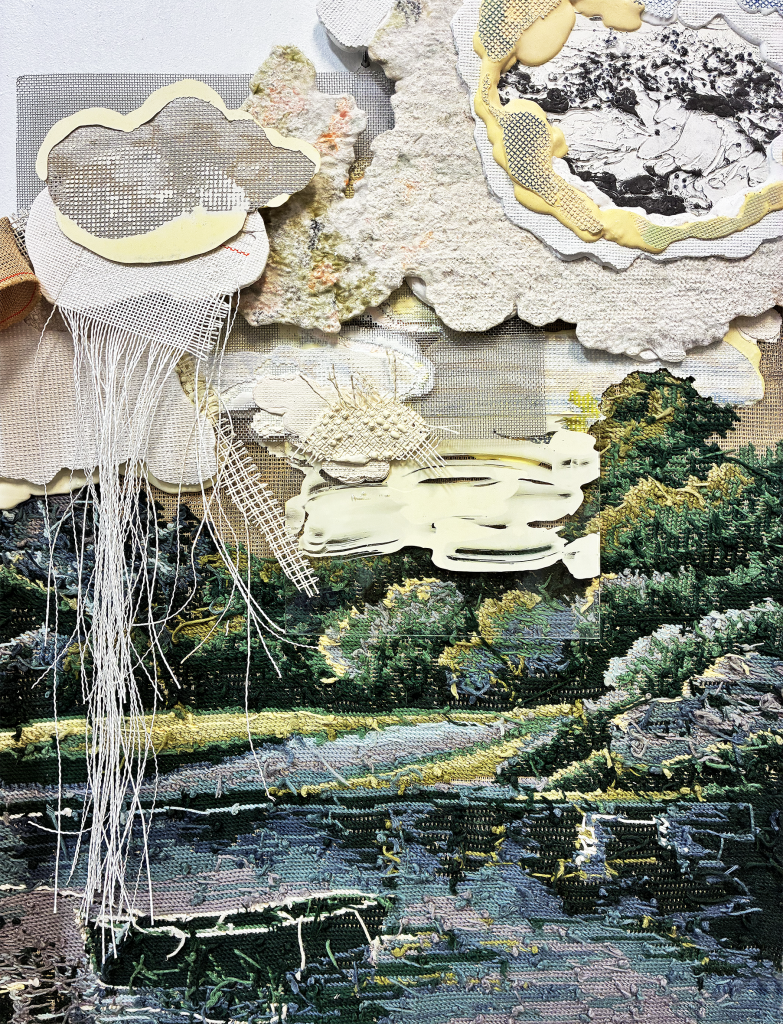
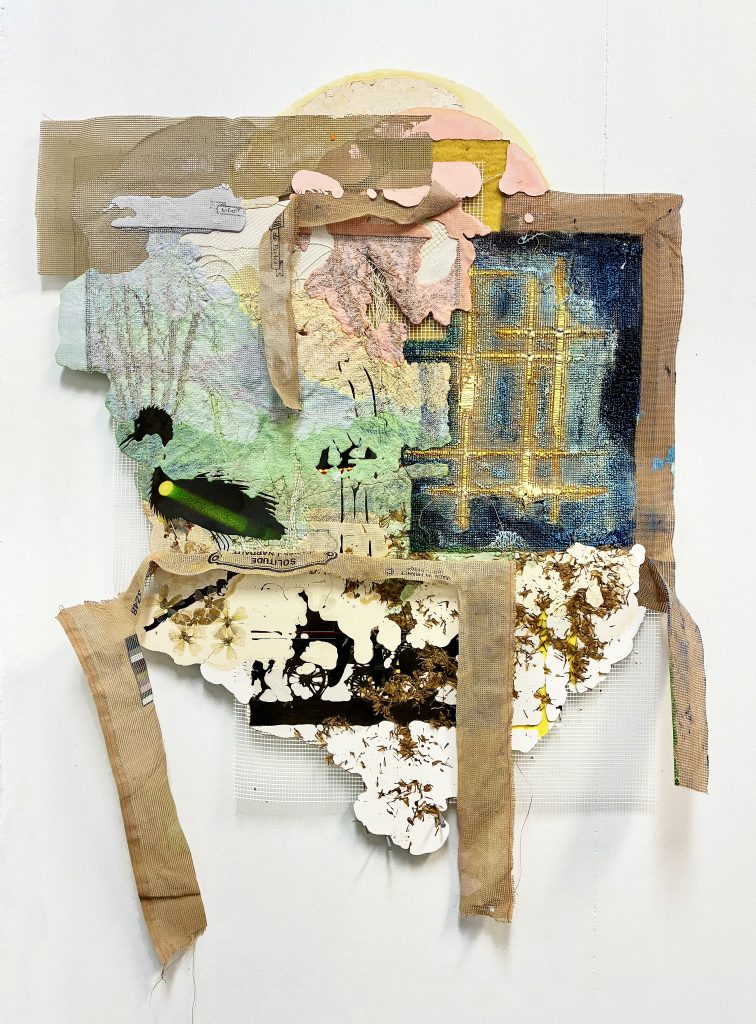
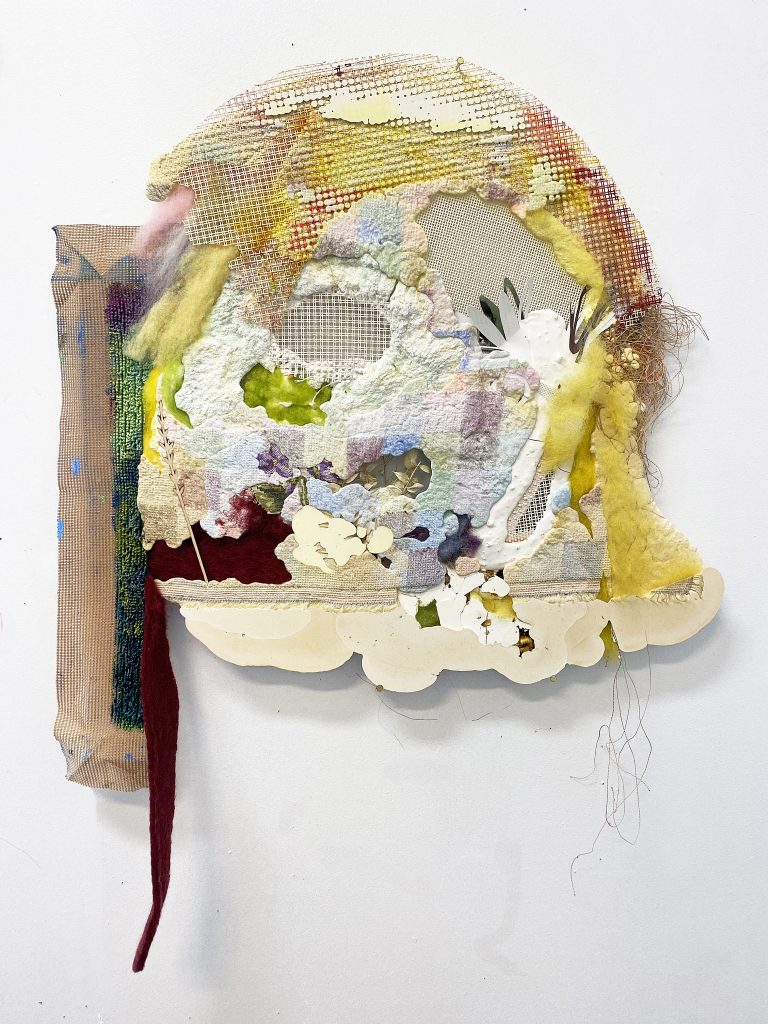
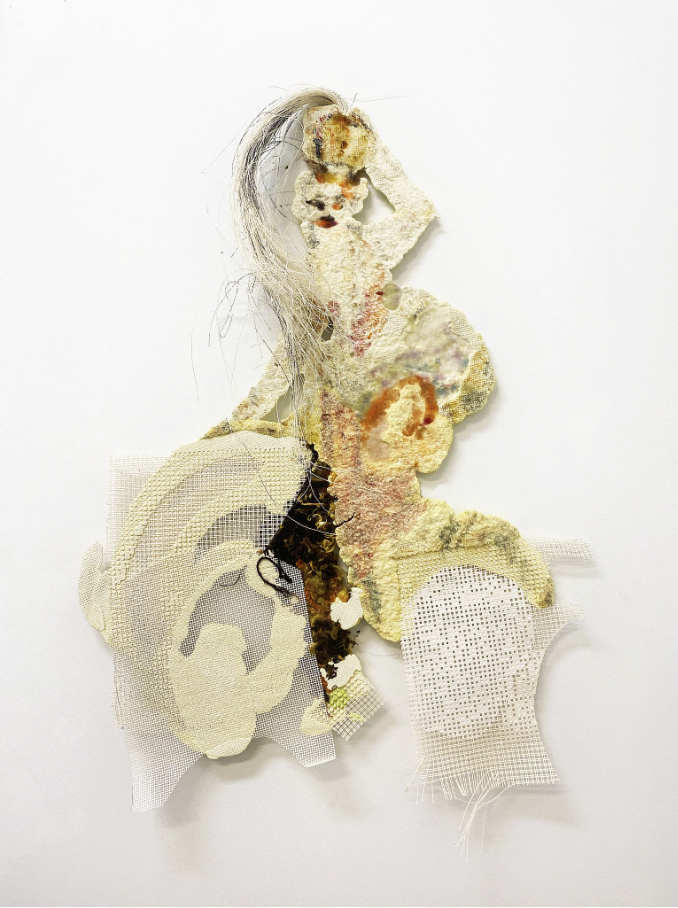

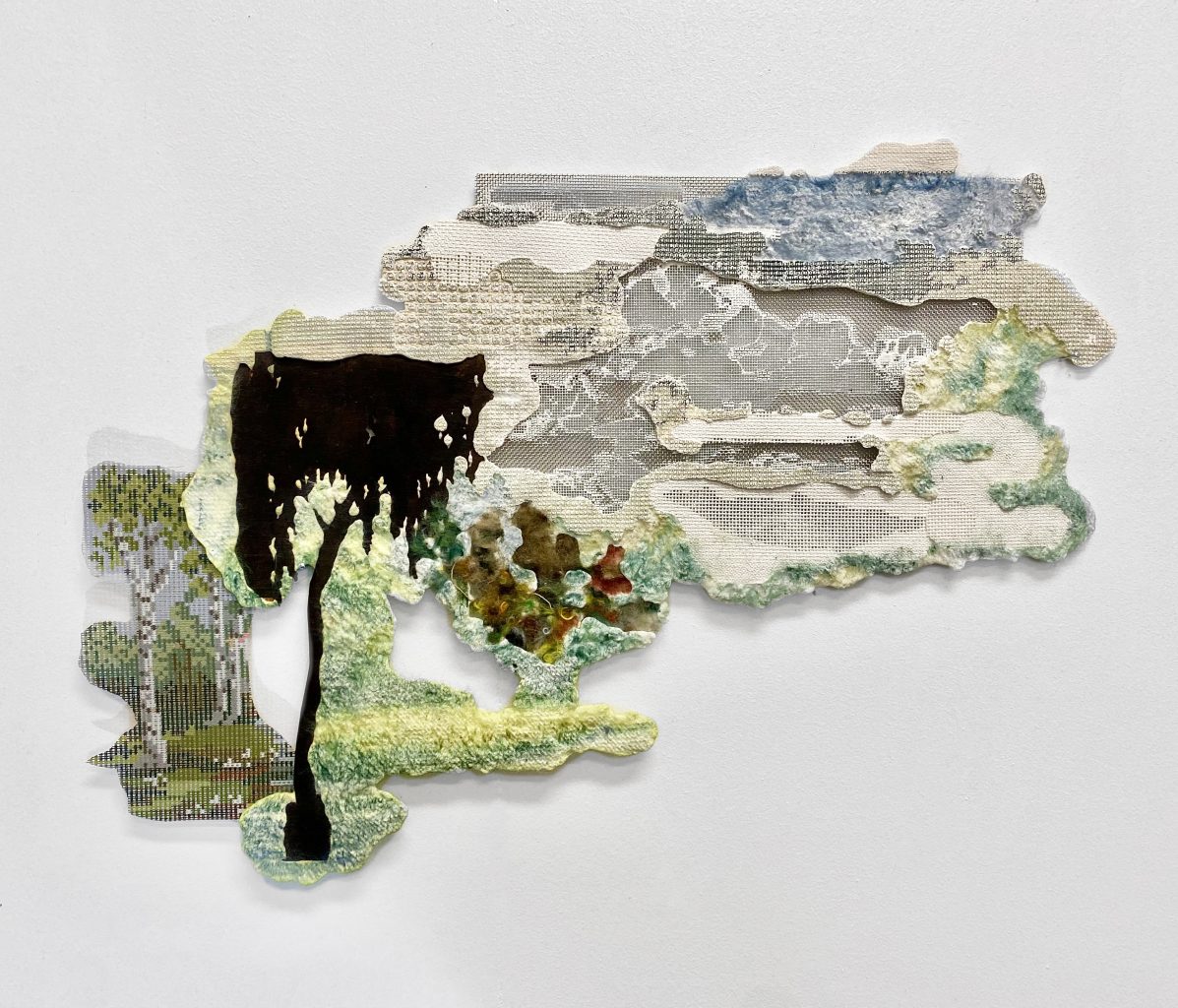

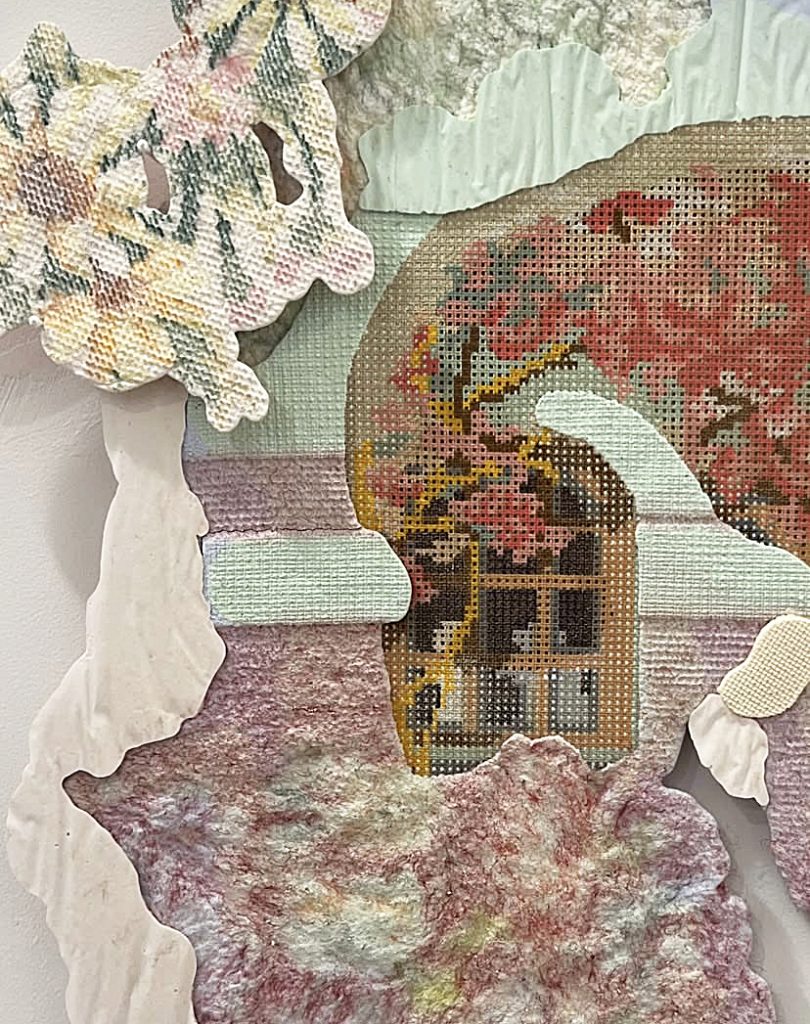


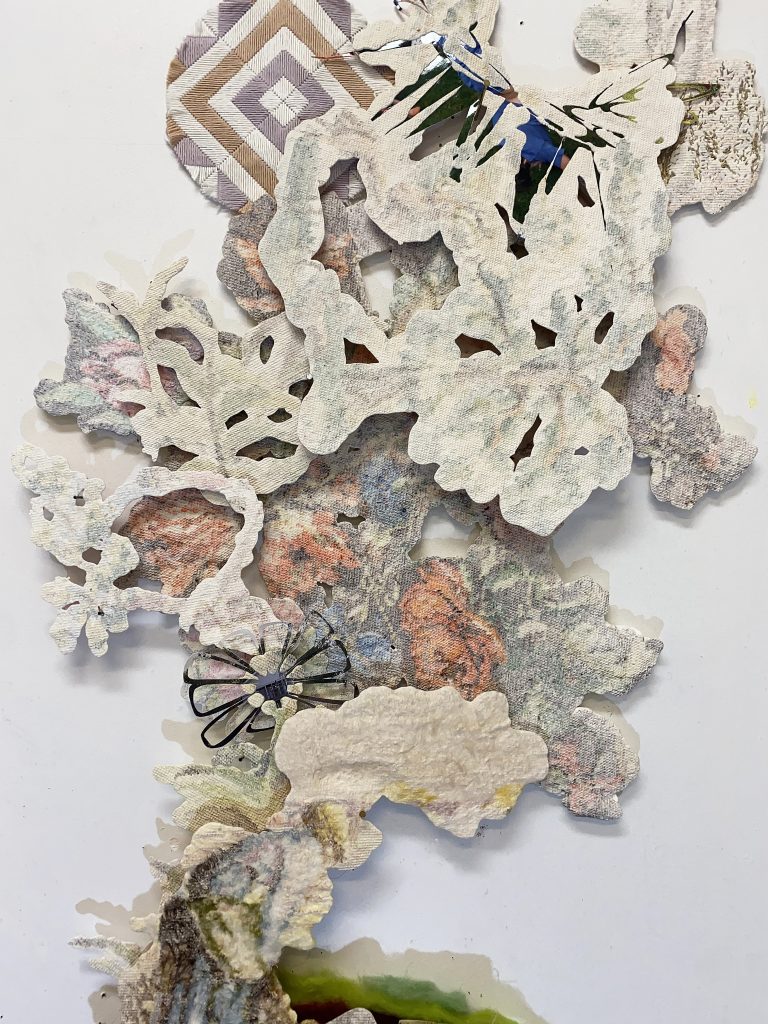
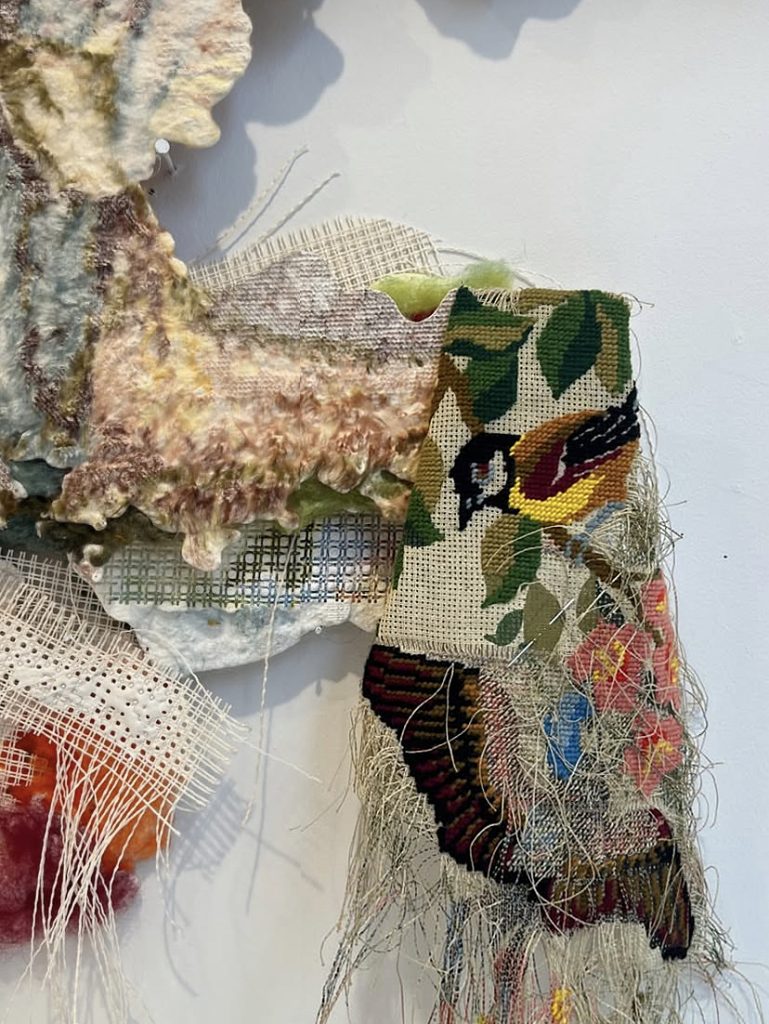
Holding Patterns brings together what I have been working on most recently in the studio: a group of many-media works in resin, built slowly from materials I have gathered and lived with over time. While my decisions in the studio are guided by materials and experience, that experience is shaped by the world around me, by images I’ve inherited, systems I’ve learned to move within, and structures that influence how value, labor, and attention circulate. The sense of strain that runs through the work is not only personal, but also a response to systems that no longer hold what they promise, continuing to function even as their limits become visible.
The work is also concerned with how images and histories are passed on. Needlepoint patterns and photographic fragments are forms meant to be repeated and shared, yet they often simplify what they carry. Over time, parts are smoothed out, cropped, or forgotten. What remains is usually what fits existing narratives. The interruptions and partial visibility in the work reflect this – moments where transmission breaks down and something slips out of reach.
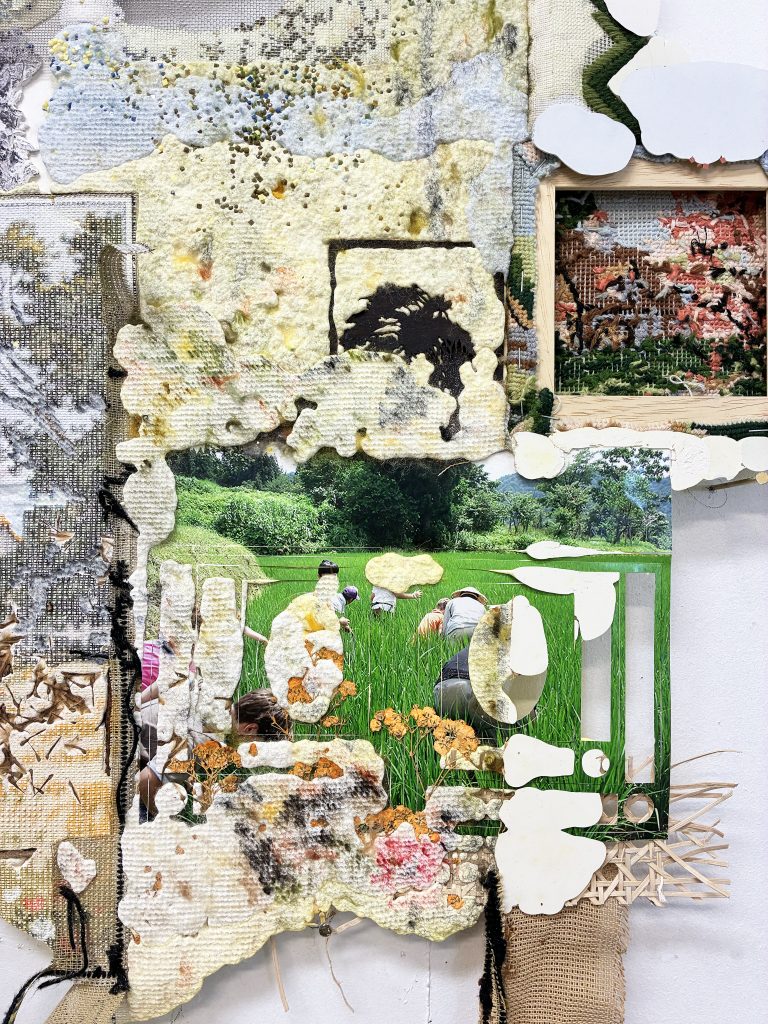
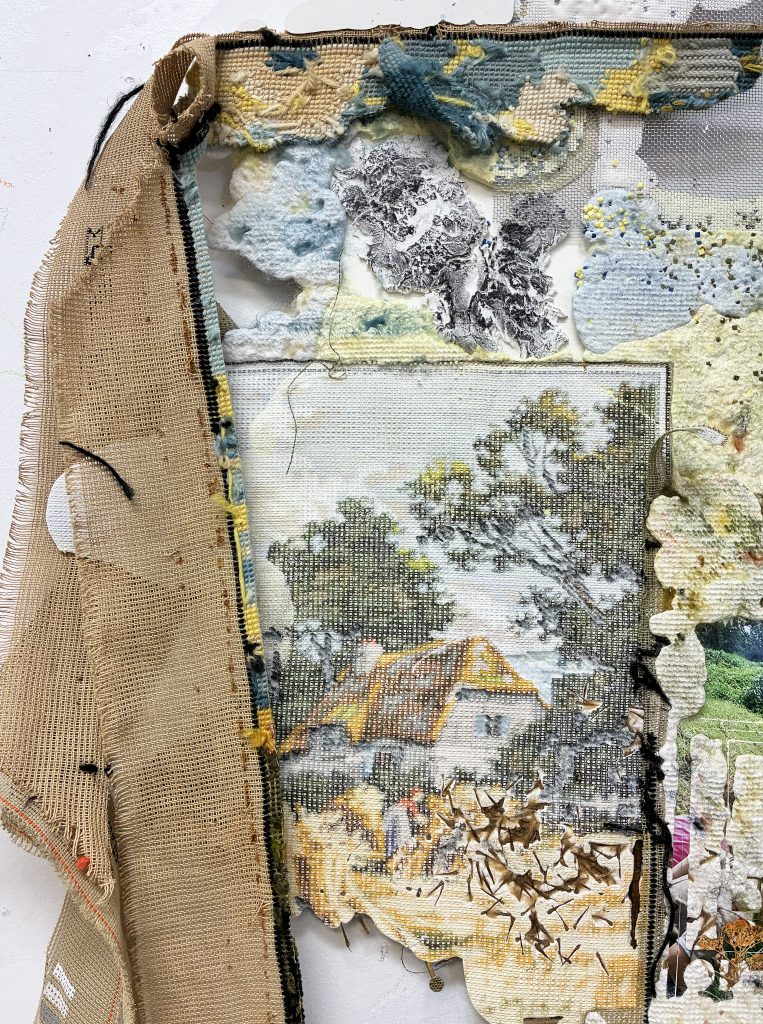
Vintage needlepoint, mesh, cut photographs, paint, seeds, and other material fragments are cut, printed, pressed, undone, and set into resin, often mid-action. Materials are slowed, interrupted, or held in suspension. Paint is pushed through needlepoint mesh, stretched and distorted under pressure; needlepoint images are undone or printed into resin and then cut away, leaving hollowed or sagging forms. Images remain only partly visible: blurred, clouded, or caught just before coming into focus.
I work incrementally and without a fixed plan, building the pieces in reverse, more like painting on glass than composing an image all at once. Layers are added from what will become the front of the work toward the back, so early decisions are made without seeing how they will finally appear. I work behind the picture, looking through it rather than at it, allowing later layers to interrupt, distort, or overtake what came before. In this process, I collaborate with the materials, setting conditions and responding as paint pushes through mesh, images shift, and forms stretch or droop under pressure. This way of working mirrors the layered, interconnected structures that shape contemporary life – requiring action without a clear view of the whole, where consequences emerge only after the fact. Once sealed in resin, these decisions cannot be revised; they remain as fixed traces of working within uncertainty.
Seen this way, Holding Patterns operates as a form of thinking rather than representation. The resin holds a strange equilibrium of pressure without collapse, of care without resolution, fixing a moment while leaving the condition itself unsettled and ongoing.
Press Release for Operation Edges (images 9-11, June 2024)
Maggie Cardelús’s ongoing work with vintage needlepoint begins with close attention to its quiet repetitions—grids, coded patterns, and proto-algorithmic logic. Since the 19th century, domestic needlework has combined strict stitching techniques with idealized pastoral imagery, enforcing discipline while offering space for meditation, care, and visible labor. Cardelús disrupts this dynamic by unraveling both the structural logic and visual language of the medium. She introduces ruptures, asymmetries, and intuitive gestures that loosen the pattern’s grip and disturb the pastoral’s soothing facade. The logic she follows is no longer algorithmic but spatial and affective, built from accretion, drift, and painterly improvisation. In doing so, she imagines a different unfolding of history—one where invention, touch, and emotional resonance take precedence over mathematical grids and control. The resin assemblages heighten this tension: resin, a synthetic binder associated with industrial permanence, encounters the softness of wool, the porosity of mesh, the brittleness of dried flowers, and the precariousness of old needlepoint, binding them together while emphasizing the incompatibility that gives the work its charge.
Through this speculative unmaking of pattern and automation, Cardelús enters into material dialogue with the anonymous makers whose hands shaped the originals. Her interventions do not erase, but extend their labor -surfacing submerged narratives and reanimating cultural techniques once constrained by utility or invisibility. By incorporating cut family snapshots, she draws a line from the mechanical flattening of stitched patterns to that of the photographic image, and onward to the algorithmic compression of digital technologies. Guided by process, she transforms these overlooked materials into unstable, resonant forms, holding space for memory, emotion, and invention as ways to rethink what making can mean.
Her work unfolds along the edges: between craft and art, repetition and rupture, presence and absence, handwork and machine work, visibility and obscurity, reproduction and improvisation, the personal and the collective, structure and drift. These thresholds are not only conceptual but also material: seams, cuts, rough edges, and frayed borders don’t just illustrate the tensions of care and control – they make them tangible, allowing the artwork to communicate the complex realities that shape both visual culture and domestic labor. In tracing and troubling these boundaries, Cardelús insists on making as a form of resistance, an act that reclaims space for complexity, subjectivity, and deep, slow, felt ways of knowing.